Ways To Save Money On 14x28x4 Air Filters Without Cutting Quality
The 14x28x4 air filter in your HVAC return has more sway over your monthly energy bill than most homeowners realize. A clean one cuts your air conditioner's energy use by 5 to 15 percent, per the U.S. Department of Energy. A clogged one does the opposite, and it lets bypass air carry pollen and pet dander straight through to your evaporator coil. While the brand on the cardboard frame matters less than most ads suggest, the real cost-control levers are how you buy a 14x28x4: at the right MERV rating, in a multi-pack, on a replacement schedule your HVAC system can keep up with.
Weston households running AC year-round burn through filters faster than most of the country. South Florida humidity puts more debris in the airstream, the cooling cycle barely stops, and a filter that might last 9 months in Minneapolis runs out at 6 here. That makes the math more consequential in this market than almost anywhere else. Choose well on a 14x28x4, and you can trim your annual filter spend by 30 to 50 percent without changing the air quality you actually breathe.
TL;DR Quick Answers
14x28x4 Air Filters
A 14x28x4 air filter is a 4-inch deep pleated furnace filter. The 14x28x4 label is the nominal size. The actual measured size is 13.5 by 27.5 by 3.63 inches. Most homes do well on MERV 8 or MERV 11, replaced every 6 to 9 months. Buying in 4-packs or 6-packs typically cuts per-filter cost by 30 to 50 percent without changing how the filter performs.
Top 5 Takeaways
Pack Size Moves Price More Than Quality. A 4-pack or 6-pack of 14x28x4 filters drops per-filter cost by 30 to 50 percent. The filter inside the box doesn't change.
MERV Rating Should Match Household Need, Not Maximum Spec. MERV 8 covers most homes, pets, and allergies, pushes you to MERV 11, and smoke exposure or asthma in the household justifies MERV 13.
Actual Size Is 13.5 X 27.5 X 3.63 Inches. Verify your slot before ordering. Nominal labels round up for shelf consistency.
Replacement Cadence Beats Brand. A premium filter run too long performs worse than a mid-range filter changed on time.
Made-In-USA Filters Hold Their Spec More Reliably. Tighter manufacturing tolerances on pleat depth, frame squareness, and media density add up over years of repeat purchases.
What Drives The Cost Of A 14x28x4 Air Filter
Four things shape the price of a 14x28x4 air filter: how thick the pleated media is, how high the MERV rating goes, where the filter is manufactured, and how many you buy in one order. Each one moves the price for a different reason, and each one offers a separate way to spend less without losing the filtration performance you actually need.
A 4-inch deep pleated filter holds about four times the surface area of a 1-inch filter at the same face dimensions. In our experience, that extra depth is what convinces most homeowners to make the switch. They get fewer changes per year, less airflow restriction, and a longer service window before the filter is exhausted. That depth is the main reason a quality 14x28x4 HVAC filter is the right pick for households that want steadier performance with less hassle.
If you want the technical background on how pleated media compares to other filtration types, the Wikipedia entry on the air filter covers it without the marketing gloss.
Higher MERV ratings cost more because denser synthetic media and tighter pleats take more material and more precise manufacturing. The capture story is fairly clean once you know what each tier does. MERV 8 catches the larger stuff like pollen and dust mite debris. MERV 11 adds finer particles, including pet dander, mold spores, and most household allergens, and that's the rating that fits most pet households or anyone with seasonal allergies. MERV 13 reaches further still, into smoke and the fine particulate that drifts in during wildfire season, which makes it the right pick for asthmatic households or anyone in a recurring-smoke region. Paying for MERV 13 when your household actually needs MERV 8 is the single most consistent money-wasting mistake we see. Homeowners assume that higher is automatically better, and the bill confirms otherwise.
Pack quantity is where the real savings hide on 14x28x4 air filters. A single filter typically costs 30 to 50 percent more per unit than the same filter ordered in a 4-pack or 6-pack. The filter inside the box doesn't change. The savings come from packaging consolidation, single-shipment cost, and the volume discount the manufacturer can pass back to the buyer.
Choosing The Right MERV Rating For Your 14x28x4
MERV stands for Minimum Efficiency Reporting Value, a 1 to 16 scale that ranks how well a filter captures airborne particles by size. Most residential HVAC systems run well on anything from MERV 8 to MERV 13. Pick the rating that matches what's actually in your indoor air, and don't overshoot.
MERV 8 For Standard Households
A MERV 8 14x28x4 air filter handles pollen, dust mite debris, household lint, and most of the day-to-day airborne stuff. Airflow restriction stays low, which is good for the blower motor and good for the energy bill. For a typical Weston household with no pets and no allergies in the family, MERV 8 is the right starting point.
MERV 11 For Pets, Allergies, And Higher Capture
A 14x28x4 air filter MERV 11 adds capture in the 1.0 to 3.0 micron range, which is where pet dander, mold spores, and most pollen fragments hang out. This is the right pick if you've got pets shedding indoors, someone in the house with seasonal or year-round allergies, or visible dust building back up within days of a deep clean. The cost step from MERV 8 to MERV 11 is usually small. The capture difference is large enough that sensitive households notice within the first replacement cycle.
MERV 13 For Smoke And Sensitive Households
A 14x28x4 air filter MERV 13 reaches into the 0.3 to 1.0 micron range, where wildfire smoke, fine combustion particulate, and viral aerosols sit. Use this rating for households with asthma, COPD, immunocompromised members, or recurring wildfire smoke exposure. There's a caveat. A MERV 13 filter creates more airflow restriction than MERV 8 or 11, so check that your HVAC system is rated for it before installing. For most healthy households, MERV 13 is more filtration than the air actually has in it to capture.
How To Save Without Cutting Quality
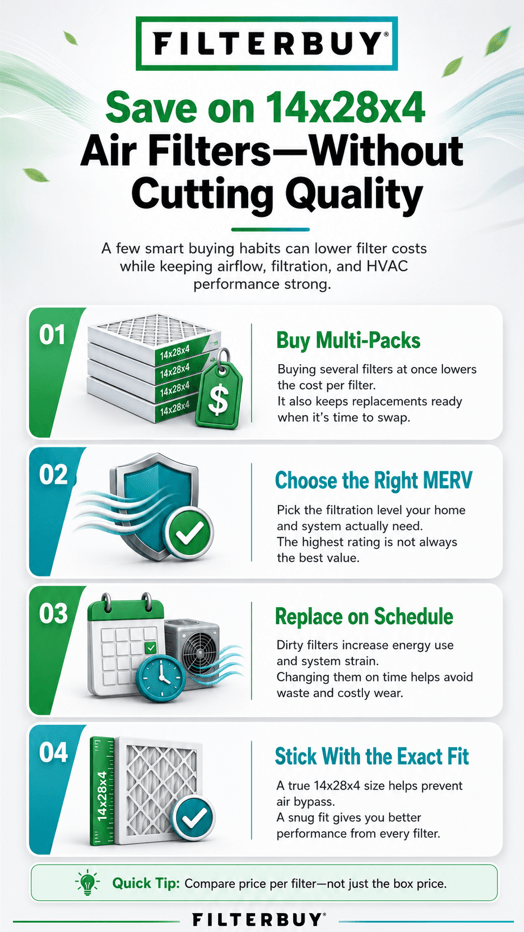
Buy In 4-Packs And 6-Packs
The biggest single-line-item savings on a 14x28x4 has nothing to do with which filter you pick. A 4-pack or 6-pack typically lands at 30 to 50 percent less per unit than buying singles, and the filter inside the package is the same one. The savings come from packaging consolidation, one shipping label instead of four, and the manufacturer passing back a volume discount.
For most households, a 4-pack covers two to three years of replacements. A 6-pack stretches further. The only reason not to buy in pack quantities is if you're not yet sure your HVAC slot accepts the 14x28x4 nominal size. In that case, order one filter first, confirm the fit, then commit to the multi-pack.
Match The MERV To Your Real Need
Most overspending on 14x28x4 filters comes from buying more filtration than the household actually has air for. A MERV 13 14x28x4 in a home that genuinely needs MERV 8 wastes money on the front end and adds airflow restriction, your blower wasn't sized for. The honest assessment of your household — pets, allergies, smoke exposure, anyone with respiratory conditions — almost always points to a MERV 8 or MERV 11 for homes without special concerns.
Stick To The Replacement Schedule
The discipline that saves the most money over time has more to do with the calendar than with which filter you bought. A 14x28x4 is rated for 6 to 9 months of typical use. Pushing it past 12, especially in Florida, where AC runs year-round, costs you more than you save. A clogged filter forces your blower motor to work harder, drives up energy use, and lets bypass air carry untrapped particulate straight into your evaporator coil. That's exactly the part of your HVAC system you most want to keep clean.
The simplest enforcement mechanism is to set a calendar reminder and keep the next filter on hand, so the swap is friction-free when the date hits.
Why Made-In-USA Filters Hold Their Spec
A 14x28x4 air filter made in the USA tends to ship with tighter tolerances on pleat depth, frame squareness, and media density. A frame that bows by even a quarter inch reduces sealing against the slot, inconsistent pleat spacing creates uneven airflow across the media, and lower-density media releases captured particulate back into the airstream as it loads up. None of these failure modes is dramatic in isolation. They show up across years of repeat purchases.
Filterbuy filters are manufactured in Alabama, Florida, Pennsylvania, and Utah, which keeps quality control close to the production line. For a recurring household purchase, that consistency matters because every filter you buy has to perform like the one before it.
When To Replace A 14x28x4 Furnace Filter
Most 14x28x4 filters carry a 6 to 9 month service rating. A few variables compress that range:
Pets in the household cut service life by 25 to 40 percent, depending on shedding intensity.
Year-round AC use, normal for households in South Florida, accelerates loading.
Higher MERV ratings load faster than lower ones because they capture more particulate per cubic foot of air.
New construction or recent renovation creates extra airborne dust that shortens the first filter's life.
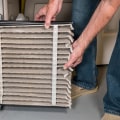
The visual check takes ten seconds. Pull the filter, hold it up to a window or any strong light source, and look at the pleated media. If light isn't passing through the pleats, the filter is loaded and ready for replacement. A filter that's gray, lumpy, or visibly compressed has been in place too long.
For a 14x28x4 furnace filter replacement schedule that doesn't require pulling the filter to check it, set the reminder at 6 months. Re-evaluate at 9 if conditions in your household are mild.
Actual Size Vs. Nominal Size
This is where most homeowner frustration with 14x28x4 filters lives. The label is the nominal size, rounded to 14 by 28 by 4 for shelf consistency. The 13.5x27.5x4 air filter is the same product at its actual measured size, 13.5 inches by 27.5 inches by 3.63 inches. The 00.5-inch gap on each face dimension is industry standard, designed to let the filter slide into the slot with a snug fit, and the actual depth of 3.63 inches accounts for the frame thickness on either side of the 4-inch nominal call-out.
Before ordering a 14x28x4 air filter or any 14 x 28 x 4 air filter variant, measure your slot directly. If the slot is closer to 1-inch depth, compare a 14x30x1 air filter for tighter slots before committing to a 4-inch.
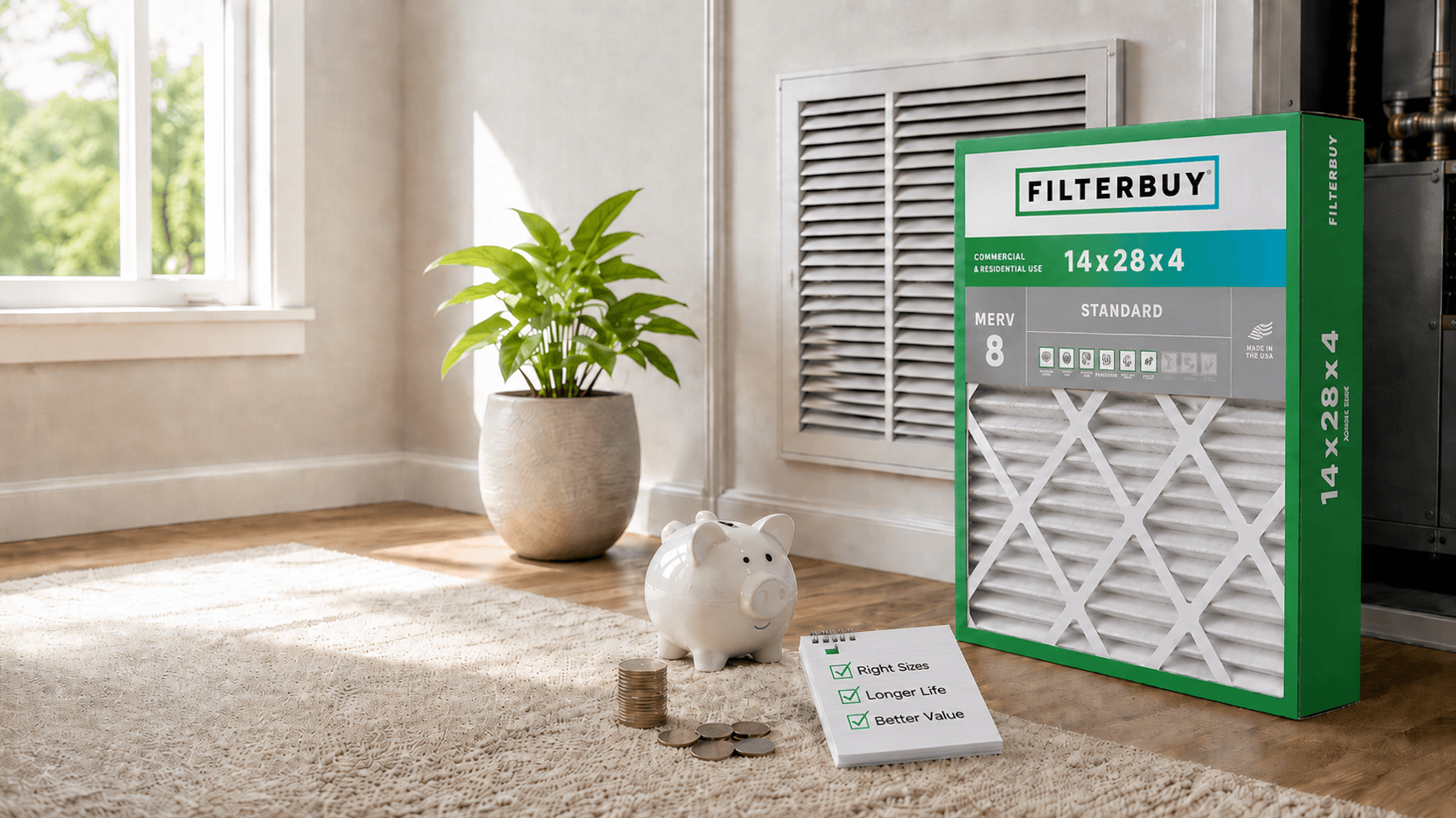
"After manufacturing filters for over a decade and serving more than two million households, the single most consistent money-wasting mistake I see on 14x28x4 orders is people reaching for MERV 13 when their household genuinely needs MERV 8 or 11. They end up paying more, restricting their airflow, and buying filtration they don't actually need."
Essential Resources
1. Cut Your Energy Bill By Maintaining Your Filter On Schedule
ENERGY STAR's federal HVAC maintenance checklist tells you exactly when to inspect, clean, or change your filter as part of a full seasonal tune-up. Useful for any Florida household running AC year-round.
Source: ENERGY STAR HVAC Maintenance Checklist
2. Understand What Sets Off Your Allergies Indoors
Pet dander, dust mites, and mold spores drive most indoor asthma and allergy flare-ups. AAFA's allergic asthma resource breaks down how each trigger behaves indoors and where filtration genuinely helps.
Source: AAFA Guide To Allergic Asthma And Indoor Triggers
3. Know What Is Actually Polluting Your Indoor Air
The American Lung Association's guide to what makes indoor air unhealthy walks through the most common pollutants by type, source, and health risk, so you know which ones your filter actually addresses.
Source: American Lung Association: What Makes Indoor Air Unhealthy
4. Pick A MERV Rating Backed By Industry Standards
ASHRAE writes the technical standards behind every MERV rating on the market. Their Position Document on Indoor Air Quality lays out the framework for thinking about IAQ in residential HVAC, including the trade-offs that come with higher-rated filtration.
Source: ASHRAE Position Document On Indoor Air Quality
5. See How Residential Filters Actually Perform
The National Air Filtration Association's residential filtration article walks through the three forces every filter has to balance: airflow resistance, dust-holding capacity, and capture efficiency. A useful primer for anyone choosing between MERV tiers.
Source: NAFA Residential Air Filtration Article
6. Get Allergist-Backed Guidance On Pet Dander And Allergens
The American Academy of Allergy, Asthma & Immunology's pet allergy resource walks pet-sensitive households through symptom management, including how filtration and a higher MERV rating fit into reducing dander exposure.
Source: AAAAI Pet Allergy Patient Resource
7. Read The Peer-Reviewed Evidence On Filtration And Allergen Reduction
This peer-reviewed study, published in NIH's PubMed Central archive, measured allergen reductions of 65 to 89 percent across dust mite, cat, and dog allergens in real bedrooms running residential air filtration. Useful real-world numbers for households deciding whether to step up the MERV rating.
Source: NIH PMC Study On Residential Air Filtration And Allergen Reduction
Supporting Statistics
Three independent statistics from federal data sources explain why filter choice and replacement cadence carry real consequences for your household budget and your family's health.
1. Clean Filters Cut HVAC Energy Use By 5 To 15 Percent
A clean 14x28x4 air filter can lower your air conditioner's energy consumption by 5 to 15 percent. Those savings compound over the 10 to 12 months of peak cooling that many South Florida households experience.
Source: U.S. Department Of Energy Air Conditioner Maintenance Guide
2. Indoor Air Is Often Two To Five Times Dirtier Than Outdoor Air
Americans spend roughly 90 percent of their time indoors, where some pollutant concentrations can be two to five times higher than typical outdoor levels. The filter on your HVAC return is doing more than most homeowners realize.
Source: EPA Report On The Environment: Indoor Air Quality
3. Roughly 25 Million Americans Live With Asthma
As of 2021, about 25 million Americans, or 7.7 percent of the population, were living with asthma. Indoor allergens like dust mites, pet dander, and mold spores are recognized triggers for many of those cases.
Source: CDC Most Recent National Asthma Data
Final Thoughts And Opinion
In our experience across thousands of household filter purchases, the pattern that holds up is consistent: most homes don't need the most expensive 14x28x4 on the market. They need the rating that matches their household, in the pack size that brings the per-filter cost down, replaced on the schedule their HVAC depends on. The cheapest filters skip on media density or frame consistency, and the highest-MERV filters add airflow restriction, which most homes don't need to begin with.
For a household with pets or mild allergies, the smart spend is a MERV 11 14x28x4 in a 4-pack or 6-pack, replaced every 6 to 9 months. That one decision typically costs less per year than buying singles in any MERV rating, and the air comes out cleaner. The best 14x28x4 air filter for any given home is the one matched to that home's actual conditions, bought in volume, and changed on time.
Frequently Asked Questions
Q: What Is The Actual Size Of A 14x28x4 Air Filter?
A: The actual size is 13.5 by 27.5 by 3.63 inches. The "14x28x4" label is the nominal size, rounded for shelf consistency. Always measure your slot before ordering to confirm the fit.
Q: How Often Should I Replace A 14x28x4 Furnace Filter?
A: Every 6 to 9 months for most households, and sooner with pets or year-round AC use common in Florida. Pull the filter and hold it up to a strong light. If you can't see light through the pleats, replace them.
Q: Is MERV 13 Worth It For A 14x28x4 Air Filter?
A: For households with asthma, COPD, immunocompromised members, or recurring wildfire smoke, yes. For everyone else, MERV 8 or MERV 11 captures what your home actually has in the air without adding the airflow restriction MERV 13 creates.
Q: Are 14x28x4 Air Filter 4-Packs And 6-Packs Really Cheaper Per Filter?
A: Yes, typically 30 to 50 percent cheaper per unit than single-filter purchases. The filter inside the pack is identical to the single-purchase version. The savings come from packaging, shipping, and volume discounts.
Q: What Is The Difference Between A 14x28x4 And A 13.5x27.5x4 Air Filter?
A: They're the same filter. 14x28x4 is the nominal size printed on the label. 13.5x27.5x4 is the actual measured size. The 0.5-inch gap on each face dimension is industry standard.
Q: Can A 14x28x4 Air Filter Help With Pet Dander And Allergies?
A: Yes, especially at MERV 11 or higher. MERV 11 captures particles in the 1.0 to 3.0 micron range, which covers most pet dander and pollen fragments. Households with multiple pets often see noticeable dust reduction within the first replacement cycle.
Q: Are 14x28x4 Air Filters Made In USA Worth The Price Difference?
A: For most homeowners, yes. Tighter manufacturing tolerances on pleat depth, frame squareness, and media density mean each filter performs more consistently than imported alternatives. For a recurring household purchase, that consistency matters.
Q: Will A Higher-MERV 14x28x4 Filter Strain My HVAC System?
A: Possibly, if your system isn't rated for the static pressure a MERV 13 creates. Older or lower-end HVAC systems are more likely to feel the restriction. Check your system specs or consult an HVAC technician before going above MERV 11.
Take Control Of Your Indoor Air On A Reasonable Budget
Pick the 14x28x4 air filter that fits your household's actual filtration needs, buy it in a pack size that brings the per-filter cost down, and put the next replacement date on your calendar today. Cleaner indoor air doesn't have to cost more than it should.
Learn more about HVAC Care from one of our HVAC solutions branches…
Filterbuy HVAC Solutions - Miami FL - Air Conditioning Service
1300 S Miami Ave Apt 4806 Miami FL 33130
(305) 306-5027
https://maps.app.goo.gl/Ci1vrL596LhvXKU79